OpenStack Backup & Disaster Recovery
Deliver backup and disaster recovery as an integrated OpenStack service. Ferry by OSIE protects instances and volumes with centrally managed policies, immutable retention, and recovery across regions. Enable tenant self-service through the OSIE portal, Horizon, and CLI while retaining control over protection standards.
Restore an instance in one command.
Recover your OpenStack instance and its disks from a backup.
openstack backup restore create --point <backup-id> --mode instance --name web-01 --flavor <flavor> --networks <network>Requires the backup CLI extension and an available instance backup.
Whole-instance backups
Capture the root disk, attached volumes, and the instance configuration required for recovery, including flavor, networks, key pair, and security groups. With the QEMU guest agent, Ferry coordinates disk snapshots within a single filesystem freeze to maintain filesystem consistency across volumes.
- Recover a complete instance in one operation
- Select a different flavor or target network
- Restore individual disks as standalone volumes
- Require explicit selection for in-place overwrite
Cross-region disaster recovery
Restore instances and volumes in a recovery region using an accessible backup repository. Recovery operates without connectivity to the source region, supporting workload restoration during a regional outage.
Recovery project bindings
Map each protected instance or volume to a project in the recovery region. Existing and subsequent backups become available in that project through the standard restore workflow.
Warm standbys
Apply new backups to standby volumes in the recovery region, reducing the volume of data that must be restored during failover.
Recovery profiles
Map flavors, networks, security groups, and volume types between regions. Validate recovery configuration with a dry run before an incident.
Policy-defined recovery targets
Specify the recovery site and RPO and RTO targets in the backup policy. Recovery point availability reflects the backup schedule and the time required to transfer and import backups.
Secondary backup copies
Maintain a copy of each backup in a secondary repository with independent retention, outside the primary repository's failure domain.
Self-service regional recovery
After recovery bindings are configured, tenants can restore instances in the target region through the OSIE portal, Horizon, or the CLI.
Backup security and service controls
Establish consistent protection standards across projects with measurable recovery objectives, enforced retention, encryption, and usage reporting.
Define and monitor recovery objectives
Define backup schedules, retention, and RPO and RTO targets in each policy. Per-plan RPO compliance reporting and scheduled backup verification provide visibility into protection status and support service-level reporting.
Protect backups with immutable retention
Use S3 Object Lock in compliance mode to prevent deletion or overwrite during the retention period, including by tenants and operators. Ferry also flags changes in backup data that may indicate ransomware activity.
Enforce retention and audit legal holds
Set retention centrally and prevent tenants from reducing it. Apply legal holds to individual backups, protection plans, or entire projects to preserve data beyond its retention period, with the reason recorded in the audit log.
Integrate with your key management service
Encrypt backups before they leave the cloud using Barbican or HashiCorp Vault, with keys scoped to a repository or protection plan. Master keys remain in your key management service and are never persisted in the Ferry database or on node disks.
Reduce backup storage and I/O
Incremental-forever backups, compression, and deduplication reduce storage consumption. On Ceph, Ferry reads only blocks changed since the previous backup. Each recovery point remains independently restorable.
Meter usage and enforce quotas
Integrate per-project protected and stored byte metrics into billing or internal chargeback through the API. Project and domain quotas control consumption while allowing already accepted backup operations to complete.
Self-service backup and recovery
Give tenants control over routine protection and recovery tasks through the OSIE portal, Horizon, the openstack backup CLI, and the API. Tenants select resources and approved policies, create on-demand backups, and restore workloads. Configured recovery bindings extend the same workflow to another region, reducing reliance on operator intervention.
- Integrated with the OSIE portal, Horizon, and CLI
- Visibility into resource protection status
- Flexible restore targets and instance configuration
- Self-service recovery across regions
Tenants select an operator-defined policy and create an instance protection plan.
openstack backup policy list -c name -c sentence

openstack backup plan create shop-servers \
  --resource-kind instance \
  --resource <server-id> \
  --policy nightly-7d-immutable \
--consistency filesystemCentralized backup policies
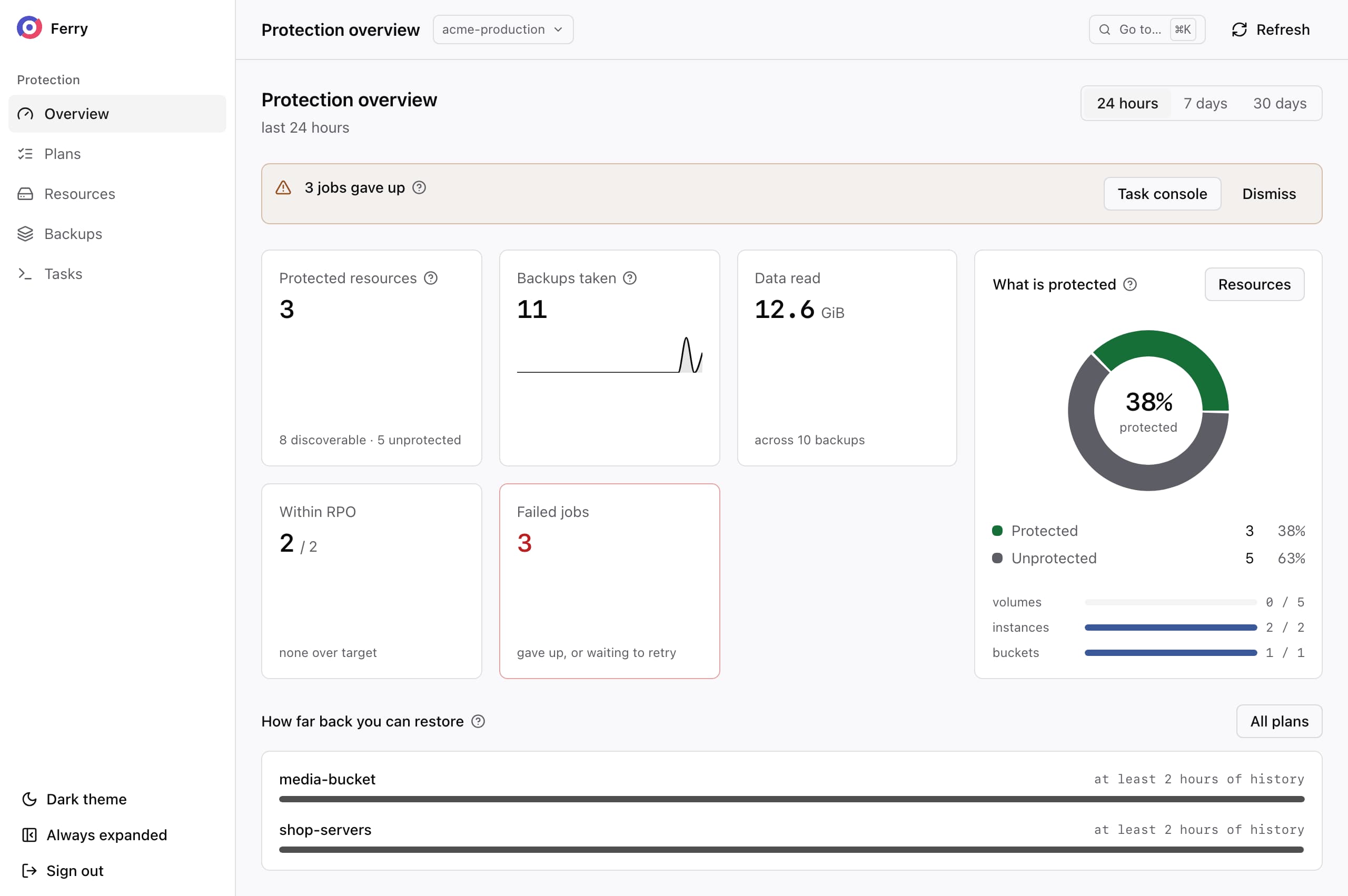
Define policies for scheduling, retention, repository selection, and recovery objectives, then assign them by project or domain. Enforce mandatory policies and prevent tenants from reducing retention. A deletion grace period supports recovery of deleted backups, while per-project coverage reports identify unprotected resources and the reasons for protection gaps.
- Mandatory policies enforced across tenant projects
- Resource quotas at project and domain level
- Usage and RPO compliance metrics through the API
Define a mandatory policy with scheduling, retention, and recovery targets, then assign it to a domain.
openstack backup policy create gold \
  --description "Nightly, a month of dailies, a year of monthlies" \
  --every 24h --at 22:00 \
  --window-start 21:00 --window-end 05:00 \
  --keep-all 168h --keep-daily 30 --keep-monthly 12 \
  --backup-repository primary-locked \
  --recovery-site <site-id> --recovery-rung warm \
  --rpo-target 24h --rto-target 1h \
  --mandatory

openstack backup policy assign gold --domain <domain-id>Deploy Ferry in your cloud
Use your existing deployment tooling to connect Ferry to OpenStack and your storage backends.
Explore deployment documentation
kolla-ansible
Add Ferry to the deployment workflow that manages your OpenStack services.
- Keystone service registration and Kolla HAProxy integration
- Logs in OpenSearch and metrics in Prometheus
- SAN fabric reads and Ceph RGW bucket protection
For OpenStack clouds managed with kolla-ansible 2025.1 or later.

Helm
Deploy a single Helm chart with presets for your OpenStack distribution.
- OpenStack-Helm 2025.1 and later
- Red Hat OpenStack Services on OpenShift (RHOSO) 18.0
- Additional distribution-specific presets
Additional presets: Atmosphere, Genestack, StarlingX, MOSK, and Yaook.

Juju
Integrate Ferry with your cloud through Juju charms and service relations.
- Two machine charms: ferry and ferry-compute
- Relations for MySQL Router, Keystone, and Ceph
- Automatic backup service registration in the catalog
For Charmed OpenStack and Sunbeam environments.
Built for day-to-day operations
Runtime requirements: OpenStack with libvirt and KVM; MariaDB 10.6+ or MySQL 8.0.16+.
Scale service capacity
Run multiple manager replicas without leader election and scale data movers horizontally.
Control storage impact
Set backup I/O limits, with automatic pauses when Ceph is unhealthy.
Recover the catalog
Rebuild the backup catalog from the repository when service metadata must be recovered.
No guest-side Ferry agent
No Ferry agent is installed in guests. Filesystem-consistent backups use the QEMU guest agent.
Protected storage
Source backends for instance, volume, and object backups.
- Ceph RBD volumes and Nova disksIncremental reads of changed blocks
- SAN arrays over iSCSI or NVMe/TCPPure, PowerStore, PowerMax, Unity, 3PAR, Nimble, Hitachi VSP, OceanStor, Storwize, Infinidat
- NetApp ONTAP over NFS, IBM GPFSFull source reads with deduplicated uploads
- Cinder LVM, Nova qcow2 and raw disksHypervisor-based disk reads
- Ceph RADOS Gateway bucketsObject-level backup
Backup repositories
Storage targets for retention, recovery, and secondary copies.
- S3-compatible object storageImmutable retention on repositories configured with S3 Object Lock
- Ceph poolDirect RADOS writes
- Mounted filesystemPOSIX filesystem paths
- Instant-restore tierCeph-backed storage for rapid volume recovery
- Secondary repositoryAdditional backup copies with independent retention
Frequently asked questions
Technical considerations for operating Ferry in an OpenStack environment. Refer to the documentation for configuration and deployment details.
Plan backup and disaster recovery for your cloud
Discuss your storage architecture, tenant protection requirements, and recovery objectives with the OSIE team. Explore the documentation for deployment details.